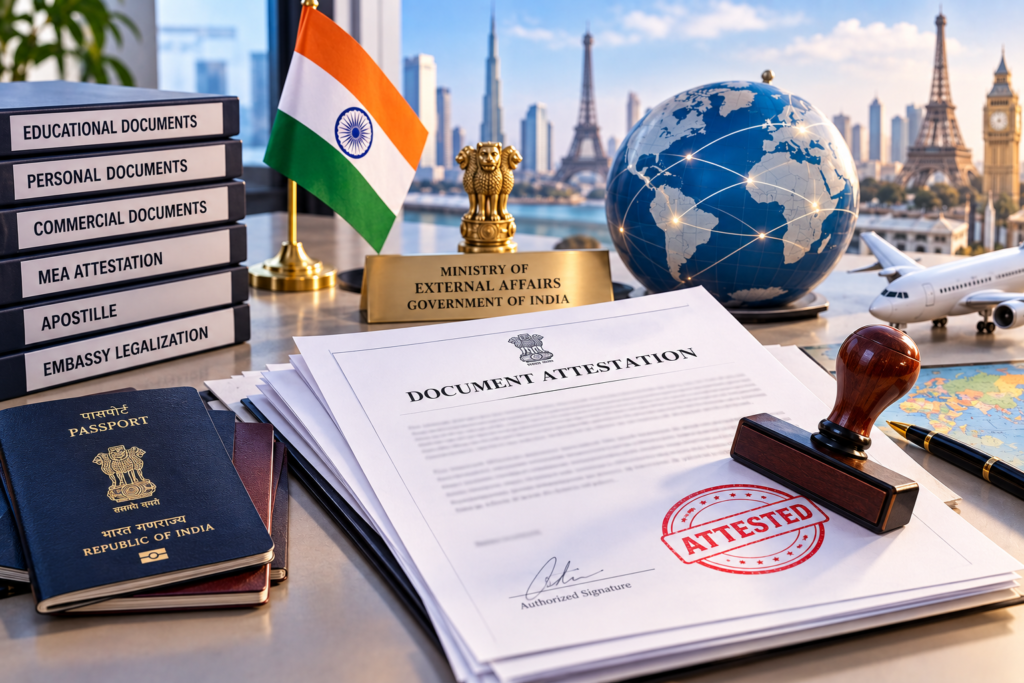
If it is necessary for an Indian document to be presented in another country, the authority receiving the document may insist that the authorities document be authenticated and certified as genuine. This may be for degree certificates, marriage certificates, birth certificates, commercial documents, powers of attorney and official documents generally. Document Attestation in India is hence a crucial step in preparing documents for abroad education, abroad job, immigration, business or personal purposes.
The Ministry of External Affairs (MEA) offers authentication for educational, personal and commercial documents which are meant for use abroad. MEA can proceed in two main ways: via Apostille for countries that are part of the Hague Apostille Convention; via normal attestation for countries that do not participate in the Hague Apostille Convention. According to the Hague Conference, the Apostille Convention does away with the chain of legalization and instead gives an Apostille by the competent authority of the country where the document was issued.
What Does Document Attestation Mean?
Attestation means the process of certifying a document to present it before any of the authorities outside India. The exact procedure will depend on the type of the document and the country in which it is going to be used.
For instance, if the certificate is issued by the education authority, then it needs to be authenticated by the education authority before it gets to MEA. Personal document may have an alternate pre-authentication journey, and commercial documents can be authenticated by a Chamber of Commerce.
MEA expressly provides that if an original document needs to be authenticated with an Apostille, then it must first be authenticated by the office of the relevant State or Union Territory as the relevant authority unless it is subject to an applicable electronic verification system.
This is a great deal more than just getting a stamp, which is what Document Attestation Services in India are about. The document must go through the appropriate authentication path for the type of document and recipient.
Apostille or Normal Attestation: Which One Is Required?
The first question asked is whether the document requires an Apostille or just normal attestation.
Apostille is used, according to the Ministry of External Affairs of India, when the documents are to be presented to countries that have ratified the Hague Apostille Convention. The normal attestation procedure applies to countries, which do not belong to the Convention or Apostille has not been accepted.
According to the HCCH, the Apostille Convention is a system aimed at speeding up the legalization process by replacing it with a single Apostille certificate issued by a competent authority designated by the State. The Ministry of External Affairs is the competent authority of India under the Convention.
For this reason, it’s best for applicants to determine the country of origin before beginning the process, rather than assuming the same kind of authentication will be needed for any and all documents sent abroad.
Which Documents Can Be Attested?
Authentication of documents may be required for their use overseas depending on the category of the document.
Educational Documents
These can include:
- Degree certificates
- Diploma certificates
- School certificates
- Academic records
- Other educational documents
MEA’s published guidance also covers certificates of educational achievement including certificates of degree, diploma, matriculation and secondary school level which can be Apostilled.
Personal Documents
Examples of personal documents include death certificates, birth certificates, marriage certificates, affidavits and powers of attorney. They may have different pre-authentication requirements depending on the issuing authority and State / Union Territory.
Commercial Documents
In international trade and commercial transactions, businesses might require authentication for documents. MEA confirms that it provides attestation services for commercial documents and that Indian businesses might need business and export-related commercial documents to be authenticated for foreign business transactions.
How Does the Attestation Process Work?
The process typically begins with an examination of the document and identifying the intended recipient and the intent of the document.
Step 1: Identify the destination
Apostille or normal attestation will be used depending on the country to which the document is being submitted.
Step 2: Check the document category
Educational, personal and commercial documents can have different pre-authentication requirements.
Step 3: Complete pre-authentication
Generally, the documents must be authenticated by the appropriate authority in the State/UT before they can be submitted for MEA authentication, MEA states. For purposes of education, documents are authenticated by the appropriate education authority while for commercial documents, they are pre-authenticated by the respective Chambers of Commerce.
Step 4: Send for MEA authentication
If appropriate pre-authentication is done, the document can then continue to the MEA process as outlined.
Step 5: Follow destination-country requirements
If the Indian stage of authentication is followed by an additional legalization or embassy/consular authentication by the foreign country, the document will be considered as normal attestation.
What is MEA Document Attestation?
MEA Document Attestation is the process of getting the documents attested from the Ministry of External Affairs for use overseas. The information officially provided by MEA is that they have an Attestation Cell for educational, commercial and personal documents for foreign use.
Note that MEA authentication is different to authentication of a university, employer, or immigration authority document. MEA authentication is not a mechanism that determines whether a foreign institution will accept the underlying qualification or information, but rather is a formal authentication of the document that will be used for international purposes.
In the case of Apostille countries, MEA is the competent authority of India under the Hague Convention.
Can Documents Be Processed Electronically?
India also has a drive called e-Sanad, which was developed by the National Informatics Centre for the online submission and verification of documents if the document exists in one of the digital repositories participating in the drive. Currently MEA’s Citizen’s Charter requirement is that only documents that can be pre authenticated via integrated State/UT systems can be Apostilled via e-Sanad, other documents will need the appropriate pre-authentication and submission route.
Applicants should not presume that each certificate will be processed the same way on the Internet.
Why Professional Assistance Can Be Useful
When multiple authorities are involved in the authentication process, it can become confusing. If there is an error in the document, or if the wrong route is chosen or the wrong pre-authentication is used, extra work and time may be incurred.
Professional Certificate Attestation Services can assist applicants in determining the documents that need to be attested, the preliminary verification steps needed, and the method for attaining the country of interest.
Likewise, Document Authentication Services can be helpful for enterprises and individuals that have a number of documents or do not know how the Indian authentication system works.
Its aim is not to replace the Government authentication procedure, but to assist the applicant in coordinating the necessary steps properly.
Services for Document Attestation in India for Foreign Usage
If you are preparing your documents for another country, it is important that the appropriate process is identified before submitting your documents. Legalization of documents may come into the picture if the destination country uses the legalization process as compared to the Apostille process.
Vedic Global Services offers services of document attestation and foreign usage requirements. This may be quite helpful if the applicant requires help in arranging their educational, personal, and business documents.
At Document Attestation Point, the applicants can receive assistance regarding Document Attestation in India, Apostille, MEA attestation, and other destination-specific requirements.
Pre-submission checklist
Prior to initiating the process, make sure to consider:
- The country where the document needs to be used
- Whether the said country recognizes Apostille
- Type of the document
- Issuing agency
- Whether pre-authentication is necessary
- Whether translation is required
- Whether additional legalization is needed by the foreign agency
- Whether an original or acceptable digital copy of the document is required
HCCH has stated that Apostille can be issued only by the competent authority in the signatory nation. In India, this designated competent authority is the Ministry of External Affairs.
Having an idea of the requirements prior to submission makes coordination of Document Legalization Services easy and avoids unnecessary hassles. It all depends upon whether the document requires Apostille, regular attestation or additional legalization.