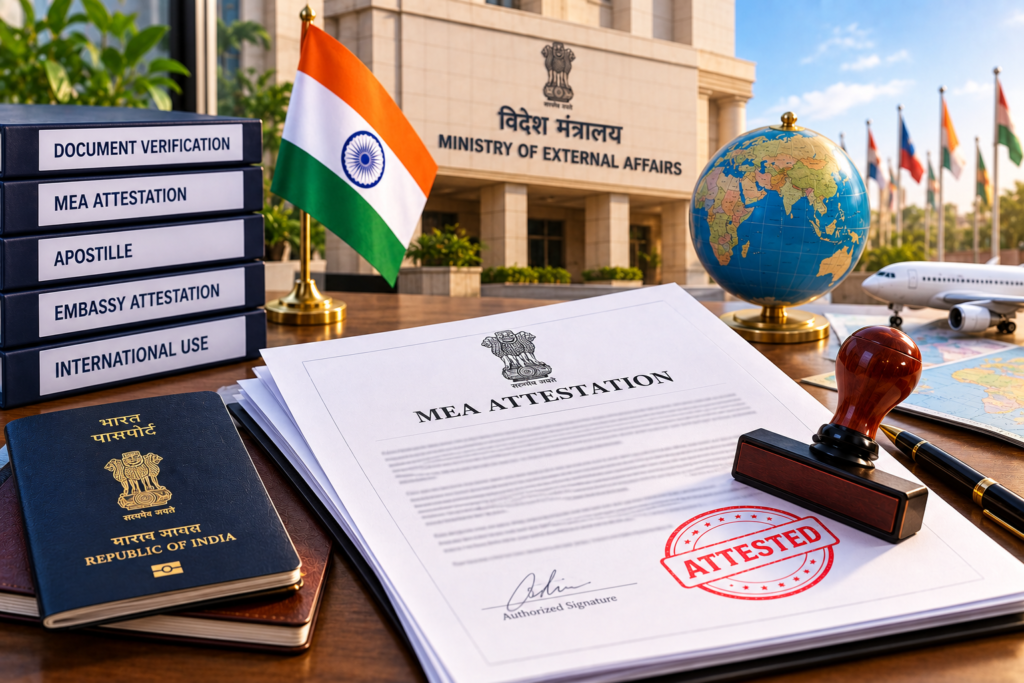
The documents issued in India may require authentication before they can be submitted to a foreign authority. The route of authentication can vary when the document is for a degree, marriage certificate for immigration, or a commercial document that is being sent for an international transaction. One of the integral components of this process is MEA Attestation Services as the Ministry of External Affairs (MEA) is the government department that handles Apostille and normal attestation of documents for use in foreign countries.
MEA states that the Apostille procedure is used for documents issued to Hague Convention countries and the normal attestation procedure is used for documents issued to countries not accepting Apostille. It is important for the applicants to understand the requirements prior to submission to ensure that they do not select an inappropriate authentication pathway or prepare documents in an inappropriate format. mea.gov.in
What is Meant by MEA Attestation?
Ministry of External Affairs Attestation is the process of authentication performed by the Ministry of External Affairs of the Government of India for documents meant for use outside of India.
But, MEA authentication need not be the first step. According to the published procedure of MEA, documents are to be pre-authenticated by the designated authority in general before being submitted for Apostille or normal attestation. Depending on the type of document, the authority responsible for this preliminary authentication will vary.
In cases where educational documents need to be authenticated, for example, by the appropriate State or Union Territory education authority. Commercial documents are usually pre-authenticated via the appropriate Chamber of Commerce. Authentication of personal documents may be followed by the authentication process as prescribed by the concerned State or UT authority.
This is not an end-to-end authentication but a part of a bigger authentication chain called MEA Certificate Attestation.
Apostille and Normal Attestation Are Not the Same
The first step of the MEA Attestation Process is to identify the destination country.
India is one of the signatories of the Convention of The Hague. According to MEA, Apostille is applied for documents which are intended for countries which are signatories to the Convention. When a country is not a member of the Hague Convention or Apostille is not accepted, the normal attestation process applies. mea.gov.in
The Hague Conference on Private International Law clarifies how the Apostille Convention will supersede a legalization system of successive stamps. MEA is the competent authority of India. hcch.net
So, MEA Attestation Abroad isn’t necessarily going to include a standard MEA stamp. The last authentication method will be the one that will be applied to the destination based on the international framework that applies there.
Which Documents Can Be Submitted?
There are a variety of general categories to MEA authentication.
Educational Documents
This may include documentation of school records, school certificates, degrees and diplomas. Educational certificates are included in the list of documents eligible for Apostille/attestation that are officially provided by MEA, with proper pre-authentication details.
Personal Documents
Some birth, marriage, death certificates and some powers of attorney might need to be authenticated for use abroad.
Commercial Documents
Commercial certificates, invoices, incorporation documents, powers of attorney and other documents may require business to be authenticated for use in international business.
It is quite possible that the appropriate preliminary authentication may differ significantly between these categories. This is why it is important to plan MEA Document Attestation around the document and not one process for each certificate.
Understanding the MEA Attestation Process
One good way to do this is to view the authentication as a series of government counters, instead of a single one.
1. Establish the Purpose
Think about and determine why you are submitting the document abroad. There may be variations in the requirements for education, employment, immigration, business and personal affairs.
2. Identify the Destination
Apostille or normal attestation is applicable depending on the country to where the document is destined for.
3. Complete Pre-Authentication
According to MEA’s published procedure, documents should be normally authenticated by the proper designated authority prior to MEA authentication. This could be done by the relevant State/UT education authority for educational documents or by the Chamber of Commerce for commercial documents.
4. Submit Through the Prescribed MEA Channel
This is the channel to use for submissions.
Once the pre-authentication is done, the document can be forwarded in the route suitable to the applicable MEA. Documents are submitted to the authorised outsourced service providers for Apostille / attestation services as per the respective procedures.
5. Check for Further Requirements
In Hague countries, the Apostille is usually a substitute for the legalization process. In countries for which normal attestation is applicable, additional authentication by means of the diplomatic or consular authority of the country of destination may be necessary.
What Does MEA Attestation Actually Authenticate?
Understanding what government authentication does – and doesn’t – establish is critical.
An Apostille certifies the authenticity of a public document, its signature, the capacity of the person who signed the document and, if it has a seal or stamp, that person’s identity. The HCCH is clear that the Apostille Convention does not certify the contents of the document as such.
Similarly, Ministry of External Affairs Attestation should not be confused with academic equivalence or professional recognition. A foreign university, employer, licensing body or immigration authority may still make its own assessment of whether the document meets the requirements.
Why Pre-Authentication Matters
A large number of applicants believe that they are able to submit their original certificate immediately for the purpose of being authenticated for MEA. In practice, it may be necessary to have it duly authenticated by the appropriate authority.
MEA has a set of its own procedure for educational, personal and commercial documents with separate pre-authentication channels.
This is one of the areas where professional help can prove useful. If the document is not properly authenticated prior to this, it will not advance through the subsequent MEA Attestation Process.
In What Situations Do You Require MEA Attestation for Abroad?
A MEA Attestation for Abroad is typically required when individuals need to submit documents from India to foreign institutions or authorities. Typical situations include:
- Overseas employment
- Higher education
- Work or residence visa applications
- Family or spouse immigration
- International business transactions
- Foreign government submissions
- Professional registration
This will always need to be checked with the authority to whom the document is being sent.
Choosing Professional MEA Attestation Support
Easier to manage the authentication process when a document type, destination and receiving authority have been identified prior to submission.
Document Attestation Point offers support on MEA Attestation Services such as educational, personal, and commercial document attestation. Multiple documents can use multiple preliminary authentication pathways which is where coordination can help.
For those individuals looking forward to MEA Certificate Attestation, the process can help in organizing and coordinating the relevant documents and stages. Likewise, for organizations looking forward to MEA Document Attestation, guidance can be obtained as regards the authentication process.
Final Word
What one needs to take note of with respect to MEA Attestation Process is the fact that there is no standard process for every document that has originated in India. The type of document, issuing agency, destination and purpose of use are some of the factors that determine the process.
In cases involving MEA Apostille, destinations under the Hague Convention become the key consideration. In case destinations do not accept apostille, then attestation and even legalization may be required.
MEA Attestation Services provide a clear understanding of the process with regard to how one is supposed to have the documents attested as per the specific requirements. When getting MEA Attestation for Abroad, it is important to check the relevant requirements.