
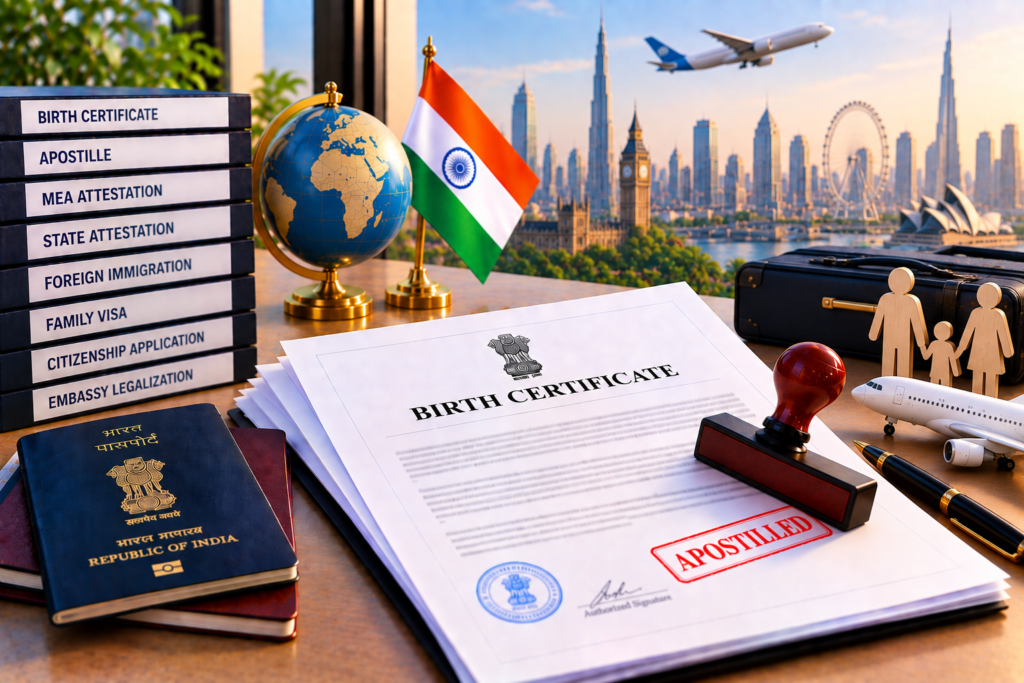
One of the most significant civil birth certificates for international immigration, family reunification, citizenship applications and overseas visa procedures is a birth certificate. If an Indian birth certificate is to be presented in a country that accepts the Apostille under the Hague Convention, Birth Certificate Apostille serves to certify the authenticity of the birth certificate from India. Different countries have different authentication procedures and the immigration authority to which the document is sent will have different requirements.
Before applying for Apostille birth certificate for abroad, one should know the difference between Apostille, embassy attestation or traditional legalisation of a birth certificate.
When Is a Birth Certificate Apostille Required?
The Birth Certificate Apostille India is typically used when a birth certificate issued by India’s government is presented to an authority in a country which is a signatory to the Hague Apostille Convention and will accept Apostilled public documents.
The Hague Apostille Convention facilitates the legalisation of public documents by eliminating the tedious and time-consuming legalisation procedure and opting for a single Apostille from the competent authority of the document’s country of origin. Birth Certificates are some of the typical civil status documents to which Apostilles can be affixed.
A birth certificate may be used for immigration related purposes to establish:
- Birthday & address
- Parent-child relationship
- Identity information
- Family relationship (dependent applications)
- Qualification for citizenship or residency.
- Attaching additional data to visa applications.
The receiving immigration authority, however, makes the final decision on the need for an Apostille and any other documents or translations he/she may need.
How Does Birth Certificate Apostille Work in India?
The procedure starts with a proper birth certificate provided by the competent Indian party.
The Ministry of External Affairs (MEA) has confirmed that birth certificates are personal documents that are eligible for Apostille. For documents not covered by e-Sanad, the authentication of documents prior to submission is done based on MEA’s published procedure via MEA’s authorized service providers for outsourcing authentication.
The typical Indian Birth Certificate Apostille process may include:
1. check the birth certificate;
The certificate must be produced by the competent registration body, and provide clear and consistent information.
2. Complete pre-authentication:
MEA’s guidance specifies that documents relating to the personal characteristics of an applicant should be certified by the appropriate Home/General Administration Department of the State/Union Territory before the MEA stage.
3. Submit via the designated process:
Documents not covered by e-Sanad are submitted via an authorized outsourced service provider, following the process of authentication.
4. Obtain the Apostille:
The Apostille is issued by the competent authority following the step of authentication.
This is a procedure for authentication of the origin of the birth certificate, not just the stamping of a Birth Certificate photocopy.
What Does an Apostille Actually Authenticate?
An Apostille cannot verify the information contained in a birth certificate.
The Hague framework was adopted to verify the signature or seal and the authority of the person who signed or issued a public document by authenticating its origin.
This is especially crucial in immigration applications.
An Apostille, for instance, does not check the accuracy of the date of birth of the applicant. Instead, it verifies the authenticity of the document’s official origin in order for the foreign authority to recognize it as an official document.
Thus, an Indian Birth Certificate Apostille is not an immigration verification document; it’s a document for international use.
Which Embassy is Apostille or Birth Certificate?
One if the frequent questions asked is whether an Apostilled Birth Certificate or Birth Certificate Embassy Attestation is required.
It all depends on the country where you are headed.
There may be an Apostille route if the destination is a Hague Convention country that recognizes Apostille. Apostille is not accepted in countries that are not part of the Hague Apostille system and normal attestation or legalization might need to be performed.
MEA explicitly mentions it is used for countries where Apostille are accepted under the Hague Convention, and normal attestation in countries that are not members and where Apostille is not accepted.
So, it is not advisable to add Birth Certificate Embassy Attestation after the Apostille is issued. The path of authentication should be agreed upon with the receiving country’s requirements.
Birth Certificate Legalization for Non-Hague Countries
If the country to which the document is being sent does not recognize Apostille, Birth Certificate Legalization may be required.
In this case, the birth certificate can then undergo the necessary Indian authentication procedures and then go through the legalization process of the final country. It may be the embassy or consulate of the country in India.
This is not an Apostille Birth Certificate for Abroad. Apostille is built on the framework of Hague Convention, with the traditional legalization being the chain of authentication necessary for the particular nation where the document is to be used.
Hence the applicants are advised to check the latest instructions of the embassy from the country concerned and also the immigration authority prior to the processing of the certificate.
What Documents Should Be Checked Before Apostille?
It is advisable to thoroughly examine the Birth Certificate before applying for Birth Certificate Apostille.
The following information should be uniform:
- Full name
- Date of birth
- Place of birth
- Parents’ names
- Registration details
- Issuing authority
- Seals and signatures
In the event of any discrepancies between the birth certificate and the passport or other immigration document, this should be resolved prior to the authentication process in the event that this is required.
Furthermore, MEA verifies authenticity of documents or true copies as applicable and will not legalize photocopies.
When your application calls for a certified translation, applicants need to also determine that the translation must be certified or authenticated.
Can Foreign Immigration Authority Demand Anything Else?
Yes. Birth Certificate Apostille India does not warrant that the immigration authority will accept the Birth Certificate without requesting anything else.
An immigration office may request:
- Certified translation
- Additional identity documents
- Proof of relationship
- Original birth certificate
- Copies of supporting records
- Additional forms required for the specific immigration application
The Apostille does not certify the document’s authenticity; it merely verifies its official origin and the foreign authority determines the type of evidence required for immigration purposes.
Applicants should thus refer to the specific list of documents required by the immigration authority of the country of destination.
How Document Attestation Point Can Assist
At Document Attestation Point, we assist applicants seeking Indian documents attestation services.
Where applicants require Birth Certificate Apostille, our services may include an evaluation of the required authentication process, document requirements as well as coordinating the needed steps.
In case where an Apostille Birth Certificate for Abroad is required by the destination country, we can assist the applicant with understanding the relevant Apostille process. Where an Apostille is not required, we may assist the applicant to understand the process for Birth Certificate Legalization or Birth Certificate Embassy Attestation.
Our goal is to organize the process and assist the applicant to avoid making mistakes regarding the appropriate authentication process to pursue.
Prepare the Birth Certificate for Its Destination
Although a birth certificate can be just a civil document, its requirements for international authentication will greatly depend on where it will be used.
In case where the foreign country is a member of the Hague Convention, Birth Certificate Apostille India will offer the appropriate authentication process for international use. In case where Apostille is not acceptable, Birth Certificate Legalization or Birth Certificate Embassy Attestation may be necessary.
Applicants planning to undertake an Indian Birth Certificate Apostille should verify the document requirements of the foreign immigration department, ensure that the information included is correct as well as find out if the document will need to be translated or any other document submitted together.