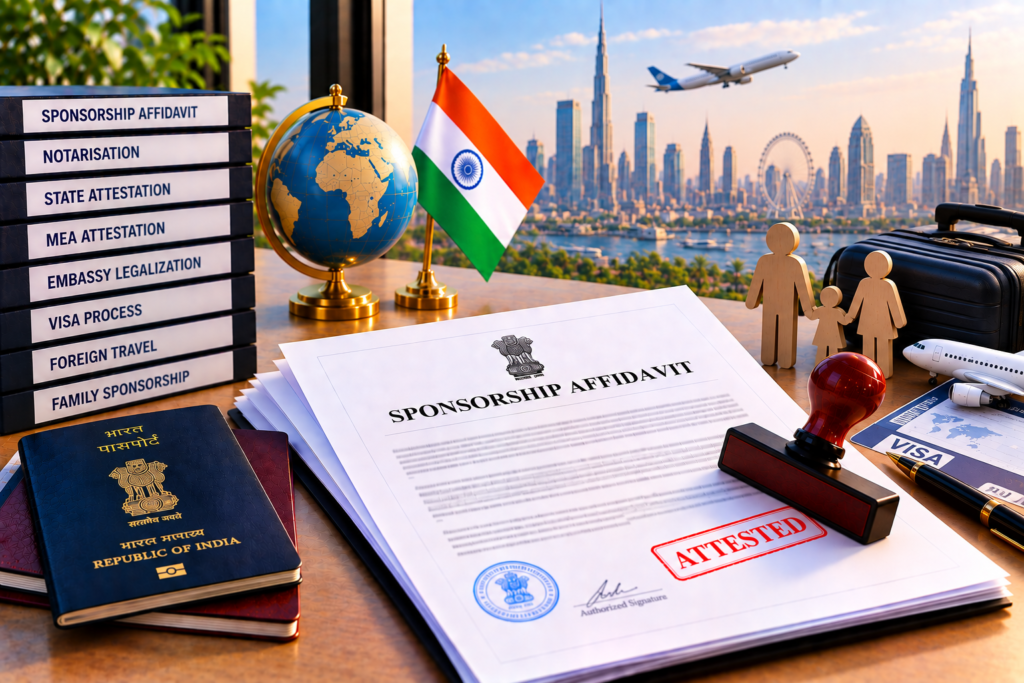
Sponsorship affidavit are usually submitted where a person agrees to provide financial support during an overseas visit, education, family migration or other visa process to another person. If the affidavit is drafted in India but required to be submitted to an overseas government, authentication will be a significant aspect of the paperwork. The route required may vary depending on visa category, instructions of receiving authority and the country of destination.
Therefore, it is essential to organize the Sponsorship Affidavit Attestation as per the actual need of the person concerned from another country.
What Does a Sponsorship Affidavit Establish?
A sponsorship affidavit is an official statement from the sponsor. It often specifies the sponsor, describes the sponsorship relationship (if applicable) and documents the commitment of the sponsor for the provision of specific financial or other support.
The document can be submitted in various cases for a student’s education, for the expenses of a dependent, for a family member’s visit or in any case where a student has to demonstrate financial sponsorship for another visa application.
Signing a Sponsorship Affidavit for Abroad does not guarantee that visas will be granted. Rather, it is an additional piece of evidence that may be taken into account with the applicant’s visa applications, financial documents, identification documents and other evidence sought by the foreign authority.
The language used should thus be suited to the purpose of the affidavit to be filed.
Before Attestation, Establish the Destination’s Requirement
The first place to begin is to find out what the foreign authority really wants.
A notarized sponsorship affidavit might be required by some authorities. Others might need the document to be Apostilled or Legalized prior to submission. The receiving institution may also require a specific format or require further evidence from the sponsor.
This is important because there is a difference between notarization, Apostille and embassy legalization.
The Hague Apostille system is used to simplify the use of public documents in other countries, and it will replace the legalization chain through the issuance of an Apostille by a competent authority in the country where it was produced.
As a result, Sponsor Document Attestation should only start after determining the appropriate route has been identified.
When Is Sponsorship Affidavit Apostille Used?
Sponsorship Affidavit Apostille might be required in instances where an Indian document is intended to be used in a nation where the Hague Apostille Convention is in force, and where the host nation is an apostille accepting country.
The Ministry of External Affairs is India’s competent authority for the Convention.
Guidance published by the Indian government also mentions affidavits as one of the types of personal documents for which Apostille can be issued. This clarifies that normally, personal document(s) need to be authenticated by the nominated Home/General Administration Department of the respective State/UT prior to the MEA stage.
The pre-authentication requirement for the document and issuing jurisdiction should be verified prior to submission.
An important point is that an Apostille authenticates the origin of the document. It is part of the Hague Convention and certifies the authenticity of the signature, the signature authority and, if applicable, the identity of the seal or stamp. Does NOT endorse the accuracy of the content of the document.
How the Indian Authentication Route Generally Works
In general, the Visa Sponsorship Affidavit Attestation must be drafted and signed properly to pass through the relevant visa sponsorship authentication process.
One approach to a practical sequence is to:
Drafting and presentation:
The execution of the affidavit is done as per requirements and signed in front of the proper officer, if applicable.
Pre-authentication:
Personal documents may be required to be authenticated by the relevant State/UT authority.
MEA authentication:
If destination is appropriate then the document goes through the appropriate MEA route.
Final overseas use:
The document is then submitted to the foreign authority, as per its visa requirements, for final use overseas.
The key is that the order may be different each time. MEA’s published procedure allows for Apostille for Hague Convention countries and normal attestation for countries which do not accept Apostille.
What Changes for Non-Hague Countries?
If the desired country does not recognize Apostille, Sponsorship Document Legalization might be necessary.
Traditional legalisation may be a series of authentications to the diplomatic or consular authority of the destination country. The HCCH states that multiple authentication steps may be required for the legalization of a foreign public document as the receiving country requires assurance that the foreign public document is an authentic document.
That’s why it’s not a good idea for an applicant to automatically request that an Apostille be affixed to the document, just because it’s being sent to an overseas country.
The process for Sponsorship Document Legalization may involve Indian authentication and then the appropriate embassy or consular process, depending on the country of origin. Other requirements such as translation or prescribed formats may apply.
Documents and Details That Should Be Checked
It is advisable to carefully read a sponsorship affidavit before it is authenticated. The supporting file can contain:
- Original sponsorship affidavit
- Sponsor’s passport or identity proof
- Applicant’s passport copy
- Proof of relationship, where applicable
- Address proof
- Financial evidence, if required by the visa authority
- Visa application documents
- Any country-specific forms or declarations
The names and dates of birth, passport information and relationship details should be the same throughout the documents.
Even if the affidavit is properly authenticated, if it is not well prepared, it can cause issues. The foreign authority may also ask for proof other than the authenticated affidavit that the sponsor is financially able to support the sponsor.
Why Professional Coordination Can Be Useful
The difficulty of the Sponsorship Affidavit Attestation is not just getting the stamp or certificate. The document has to follow the authentication route applicable to its intended destination.
Document Attestation Point help our clients comprehend and coordinate the proper authentication procedure for documents meant for overseas use.
In the case of a client needing Sponsor Document Attestation, the process can be evaluated based on destination, document type and purpose. In the cases where Apostille is applicable, help can be provided with the applicable Sponsorship Affidavit Apostille route. If the destination calls for traditional legalization, the relevant Sponsorship Document Legalization process can be arranged.
This way, an applicant doesn’t have to consider all foreign-document requirements the same.
Preparation of Sponsorship Affidavit for a Visa Application
In the end, the correct mode of attestation will depend on where the affidavit will be presented. One country which abides by the Hague Convention will require the use of Apostille while other countries may require regular legalization.
If an applicant is preparing a Sponsorship Affidavit for Abroad, then the best course of action will be to find out from the receiving body as to what type of documents they require and prepare the affidavit accordingly.
No matter whether it is Visa Sponsorship Affidavit Attestation, Apostille, or legalization, Document Attestation Point can help you prepare the document for presentation abroad.