
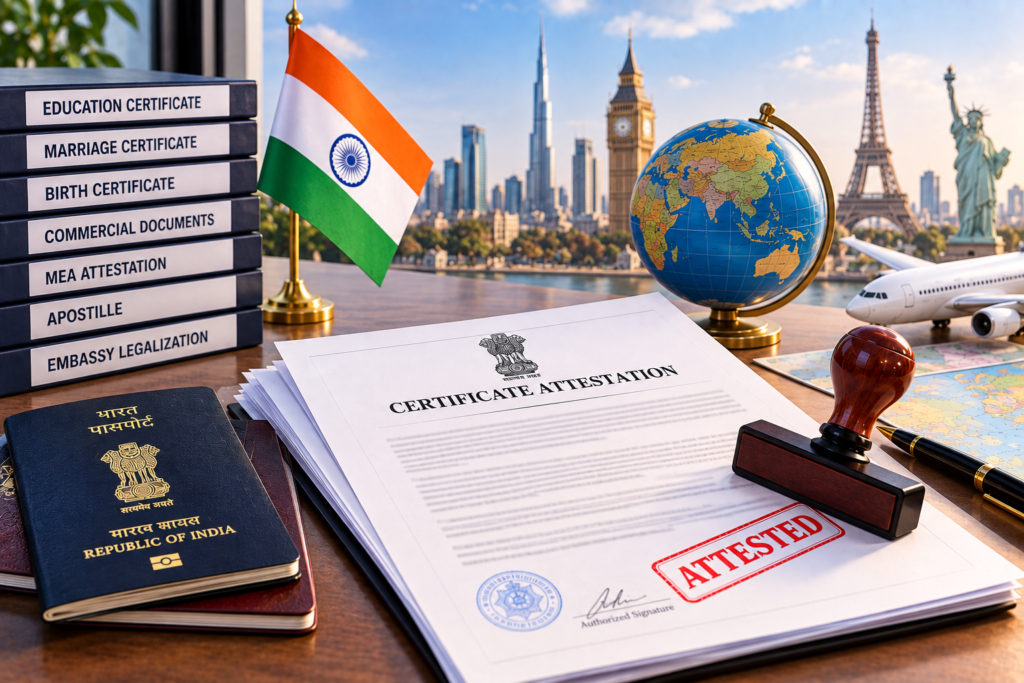
A certificate may be valid in India and not be accepted in another country without authentication. This is frequently the case when documents are submitted for employment or for further education, immigration or family issues, or international business. Indian Certificate Attestation is a process that verifies the legitimacy of a document issued by the Indian authorities and presented to a foreign authority.
But there is no universal procedure for attestation. The path may vary depending on the type of certificate, issuing authority, and country in which the certificate will be utilized. Both normal attestation and Apostille services are available at the Ministry of External Affairs (MEA); the Hague Apostille Convention offers a streamlined framework of authentication for member states. The Ministry of External Affairs is the competent authority for Apostille in India.
Why Does a Certificate Need Attestation?
Now try finishing your degree and then finding out that your marriage certificate or commercial document will not be recognized by the overseas authority without authentication. This is where Certificate Attestation Services come into play.
Attestation is a process that is used to make an overseas authority aware that the document has gone through the appropriate chain of authentication. However, it should be noted that the government’s issue of the certificate does not imply that the foreign institution approves the contents of the certificate. A university can also evaluate a qualification, an employer can carry out its own verification or immigration authorities can impose additional conditions.
Hence, the need for Certificate Attestation for Abroad isn’t just because it was issued in India, but because of the purpose and destination for which it was issued.
The First Decision: Apostille or Attestation?
Before submitting the document for Indian Certificate Attestation, it’s crucial to pinpoint the suitable path for certification.
The purpose of the Hague Apostille Convention is to preserve the “chain of custody” from the traditional legalization process and instead give the public document a single Apostille given by a competent authority in the state of origin of the public document. Currently, the HCCH has 130 Contracting Parties to the Convention on the Rights of the Child. The Ministry of External Affairs is the competent authority of India.
The Apostille Convention is applicable to documents to be sent to countries in the scope of the Convention. If Apostille is not acceptable or possible, other attestation and possibly legalisation procedures are applicable.
This difference is key to the Certificate Attestation process. It can be possible to make a decision on a service before really considering the destination, which can trigger unnecessary steps.
Which Certificates Commonly Need Authentication?
It may come in a number of categories.
Educational Certificates
Degrees, diplomas and other academic documents are frequently authenticated for overseas employment or education. Within the framework of the Apostille and attestation system, MEA has published educational documents since the required pre-authentication requirements are fulfilled.
Personal Certificates
Birth, marriage and death certificates might require authentication for immigration, family-related applications and other official documents.
Commercial Documents
For international transactions, businesses might need integrity in their documents, such as exports or other business operations. Historically, MEA has been recognizing educational, personal and commercial documents in its attestation services.
That is why Certificate Attestation Services are not restricted to academic certificates.
Understanding the Certificate Attestation Process
The Certificate Attestation Process should not be considered as one government stamp.
1. Identify the destination
The first step is to set up the country where the certificate is going to be awarded. This helps to decide whether Apostille or normal attestation is required.
2. Determine the type of document.
An educational certificate is not necessarily the same preliminary authentication process as a personal or commercial document.
3. Complete pre-authentication
According to MEA’s published Citizen’s Charter, documents from the designated State/Union territory authorities are only eligible for MEA Apostille/attestation, depending on the applicable systems, including e-Sanad.
4. Submit via the appropriate MEA pathway.
Once the initial authentication process is completed, the document continues for the desired MEA service.
5. Check the destination authority’s final requirements
Additional steps, translations or supporting documents may be required for some destinations or receiving institutions. This is especially crucial in countries where the traditional path of legalization is in practice.
What is MEA Certificate Attestation?
MEA Certificate Attestation is the process of certification by the Ministry of External Affairs in India for documents that are meant to be used outside India.
The Ministry plays a crucial role here as India has designated it as the competent authority under the Hague Apostille Convention.
As for applicants, the MEA Certificate Attestation phase ought to be undertaken just after they gain insight into the pre-authentication required for the document. First step does not have to be the first step in the journey.
There are also variations in the process of Apostilling a document vs a normal attestation.
When Is Certificate Legalization in India Required?
When the Apostille route is not applicable in the country of destination or the country of destination requires the traditional route of legalization, Certificate Legalization in India comes into play.
The Apostille system is specifically provided for in the Hague Convention, designed to do away with the time-honored legalisation requirement among signatories to the convention.
Hence, Certificate Legalization in India should not be considered as another name for Apostille by itself. The two routes can have different requirements.
Applicants are advised to check whether the country they are going to have the certificate attested for abover requires Apostille or normal authentication and legalisation of the certificate.
What About e-Sanad?
India has also created e-Sanad to ensure electronic verification and authentication of documents from the digital repositories that are participating in this. e-Sanad is a system designed for e-submission and verification procedures for Apostille and normal attestation, as described in MEA.
Not all documents, however, are best suited for the same e-path. Applicants should first check with their issuing authority and certificate to see if it is supported before thinking that physical processing is not necessary.
Common Reasons for Delays
A certificate can have issues if:
- The wrong authentication route is selected.
- Required pre-authentication is missing.
- Details on supporting documents do not match.
- The destination country’s requirements have not been checked.
- A document is submitted without the required original or acceptable verification.
- Additional legalization or translation requirements are overlooked.
These are exactly the reasons why knowing about Indian Certificate Attestation before submission is beneficial.
Professional Support for Certificate Authentication
Coordinating between various government authorities can be time-consuming for somebody who is not familiar with the authentication processes. Professional Certificate Attestation Services can assist in arranging the documents determine the path and flow of what is needed to be done to obtain them for use overseas.
Document Attestation Point offers services to individuals and companies on document certification requirements for education, personal, and commercial certificates. Whether the applicant needs MEA Certificate Attestation, Apostille or any other destination-based document legalization, it is imperative that the document undergoes an evaluation based on its purpose.
Professional service will also assist applicants to know where Certificate Legalization in India fits into the process rather than assume that all overseas documents require apostille services.
The correct way to go about certificate attestation for abroad starts with asking these questions. Once the destination and the document requirements have been known, then it is easy to establish the best course to follow regarding the certification.
To ensure successful Indian Certificate Attestation, applicants should use the right government process and verify the requirements from the receiving authority. For situations where certificate legalization in India is needed, the applicant should know the legalizing process prior to submission of the document.