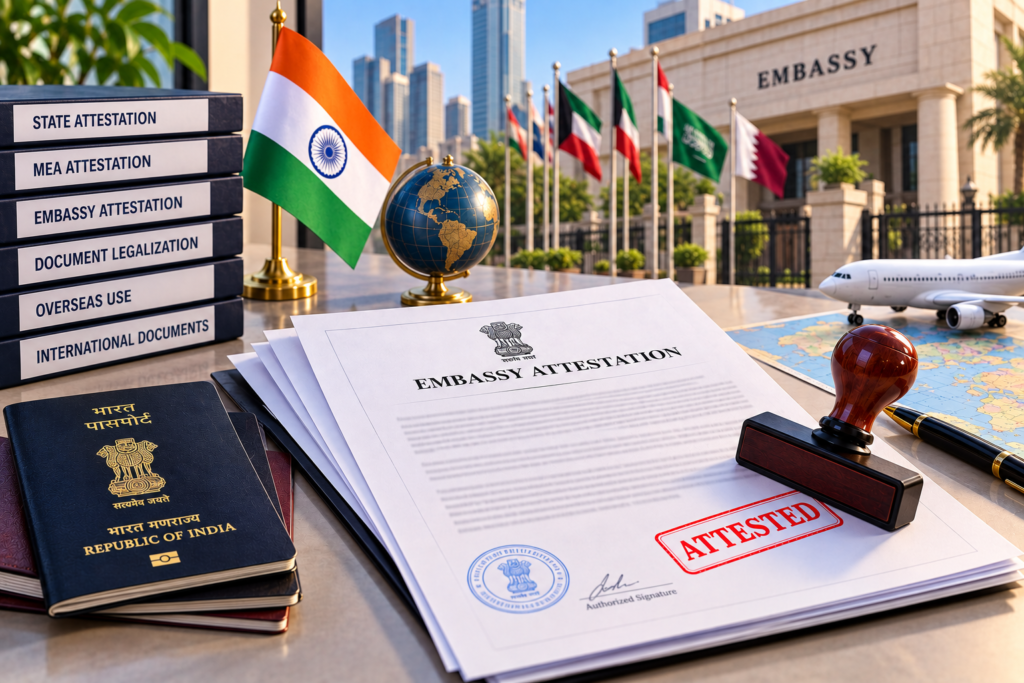
A document could be a genuine document issued by a foreign government, and it might be perfectly valid in India, but still have to be further authenticated before it is accepted by the foreign authority. This is where the Embassy Attestation in India comes into picture. There are varying authentication requirements for degrees, marriage certificates, birth certificates, commercial documents and powers of attorney presented abroad.
The key takeaway here is that embassy attestation is not the initial step. Indian documents issued for use abroad are normally authenticated to meet the needs for abroad use before being sent through the attestation / Apostille route, says the Ministry of External Affairs (MEA). If Apostille is not available, then normal attestation is used. The authenticated document will then have to be given to the relevant foreign mission for legalization in the destination as required.
Embassy Attestation Is a Destination-Specific Requirement
Each country has its own path to authentication.
It’s possible that one person might hear that they need a degree attested by the Embassy, and another with the same type of degree might only need an Apostille. The difference is typically associated with the process of recognising foreign documents in the destination country.
India has become a member of the Hague Apostille Convention since 2005. Apostille is an alternative to legalization chain for member countries. MEA offers normal attestation for countries where Apostille is not accepted.
Hence, one should start with Embassy Attestation Services from the very beginning and not just just hand over the document to an embassy.
What Happens Before the Embassy?
This is a part that is usually missed by the Applicant.
Unless the foreign mission is specifically authorized to do so, the document will not be authenticated by the foreign mission just because it has an Indian government seal on it. The document will need to go through the necessary Indian authentication process before it can be used.
According to MEA’s official document, the documents that are not covered in e-Sanad must be authenticated first and then are handed over to MEA’s authorised outsourced service provider for Apostille or attestation.
In some cases, educational documents may need to be authenticated by the designated education authority, personal documents by the relevant State or U.T. authority, and commercial documents may need to be pre-authenticated by a Chamber of Commerce.
It is only after the necessary Indian authentication has been done that the applicant should decide if the mission in the destination country needs to be followed by further authentication.
What is Embassy Certificate Attestation?
Embassy Certificate Attestation is usually a term used to describe the process of authentication and/or legalization conducted at the Embassy or Diplomatic Office of the state where the document is intended to be utilized.
The exact requirement is not exactly the same for all Embassies. A foreign mission may have its own regulations for document form, prior verification, copies, translations or passport identification or supporting documents.
The official Indian mission guidance demonstrates this difference. The documents issued in India must be authenticated by the respective State authority and then attested by MEA and then presented to the mission for attestation in one published procedure.
Hence, the applicants should take into account the latest requirement of the respective mission and not follow the general checklist available online.
A Practical Way to Understand the Process
Rather than a single authorization process it is more like a series of steps, and each authority validates each step.
Stage 1: The Document Is Issued
It all starts with the original certificate or document that the competent Indian authority issued.
Stage 2: Indian Authentication
The document may need to be pre-authenticated by the designated authority prior to it reaching MEA. It is required based on the category of the document.
Stage 3: MEA Authentication
The document then proceeds with the appropriate MEA path. There are two main services offered by MEA: Apostille for countries that are signatories to the Hague Convention and normal attestation for countries that do not sign up to the Hague Convention.
Stage 4: Foreign Mission Authentication, Where Required
The document may also need to be legalized by a further legalization at the embassy / consulate of the destination country if the country in which the document is required to be legalized follows the traditional legalization procedure.
This is where Embassy Document Attestation can come in.
Which Documents Commonly Go Through This Route?
This can be across multiple categories.
Documents like degree and diploma certificates may be included in educational documents.
Personal documents can be birth, marriage, death certificates, affidavit and powers of attorney.
Commercial documents may contain documents for international business transactions.
Personal and educational documents are explicitly mentioned under MEA as documents that can be Apostilled or normally attested and arrangements for commercial documents are also provided.
But the category of the document is not enough to determine that embassy authentication is needed.
Foreign Embassy Attestation India: Why Requirements Differ
Foreign Embassy Attestation India may refer to the process of attestation of Indian documents done by foreign embassies in India. Each mission will be a country and may set requirements in accordance with that country’s laws and administration.
Two documents that may be similar in one country could be different in another.
An MEA attestation might be required prior to accepting a certificate for one mission. Another place could be a signatory to the Apostille Convention, so that traditional embassy legalization is not needed. According to the HCCH, the purpose of the Apostille Convention was to replace the legalization process between the parties to the Convention.
Understanding the Embassy Attestation Process
The Embassy Attestation Process should thus be reversed, starting from the receiving authority.
Before asking these questions, ask the following questions:
- Which country will receive the document?
- Is the destination a Hague Apostille Convention country?
- What type of document is being submitted?
- Which authority must authenticate it first?
- Does the concerned embassy require MEA attestation?
- Is translation required?
- Does the embassy require an original, copy or additional supporting document?
With these points understood, the Embassy Attestation Process is much more easily mapped out.
Why Professional Assistance Can Make a Difference
It can be unnecessarily complicated if multiple authorities are involved in the process of authentication. Failure to submit a pre-authentication, or the wrong type of document or inappropriate legalization path may result in a re-stage.
The Embassy Attestation Services of Professionals can assist the applicants in knowing the proper path and arranging documents prior to submitting. This is especially important for educational, personal and commercial documents that are being processed concurrently.
It provides services in the area of embassy attestation in India as well as document authentication rules linked to overseas usage of the documents.
The idea is not to replace any government agencies but to assist in making sure that applicants contact the proper agency with the right paperwork.
Correct Route Selection Is Important
Embassy Certificate Attestation must not be considered an automatic rule for all Indian documents meant to be used abroad. Where Hague Convention applies, Apostille can be a substitute for legalization while other documents will require ordinary MEA attestation and legalization.
For the people who need Foreign Embassy Attestation in India, the best option is to find out about the requirements of the particular embassy or consulate as well as the receiving agency.
Through the Document Attestation Point, one can ask for help in understanding Embassy Document Attestation and completing the required paperwork according to the Embassy Attestation Process.