
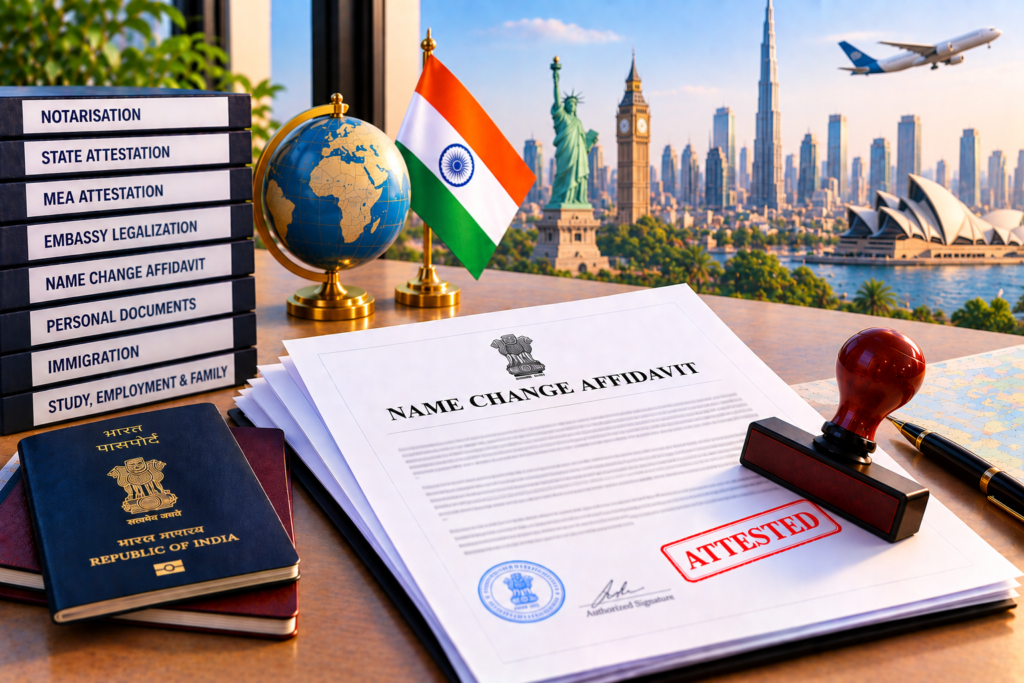
If the new name is used for immigration outside India, for education, employment, marriage, property, or other official purposes, it may be necessary to provide a formal documentary proof of the change of name in India. By having a Name Change Affidavit Attestation prepared, the connection between the old and new names is established. The document could be notarated, state authenticated, Apostille or embassy legalized, depending on the country where it is intended to be used.
Therefore, it is essential to know the proper way to do the authentication prior to filing an Affidavit for Name Change Abroad. Personal documents, which can be Apostilled for use abroad, are specifically mentioned in the Ministry of External Affairs (MEA) list.
What Is a Name Change Affidavit?
Name change affidavit is a legal document that declares that someone has changed their name or adopted a new name or is known by a different name. Can be used to explain difference between names on different documents.
For instance, a passport might contain a new name whereas an educational certificate or older document a former name. An affidavit can be used to link the two identities.
But an affidavit, only because it is notarized, isn’t necessarily internationally acceptable. The authentication needed is dependent on the country in which it is submitted and the requirements of the authority to which it is sent.
This is where Name Change Affidavit Attestation comes in handy.
When Is Name Change Affidavit Attestation Required?
When there is a difference in the personal records and a certificate of name change is required by an overseas authority, it can be attested or be presented as an affidavit.
Common situations include:
- Applying for immigration or a visa
- Admission to an overseas educational institution
- Employment or professional registration
- Marriage-related documentation
- Property or financial transactions
- Updating records with a foreign government authority
- Establishing continuity between old and new identity documents
The precise specification should be made by the organization to which the document is being sent. Some offices may request an affidavit, and others may request an officially registered name change certificate and/or other supporting documents.
Thus, Affidavit for Name Change Abroad should be drafted for the purposes for which it will be used.
Does a Name Change Affidavit Need Notarization First?
The affidavit is often first executed and notarized before it is taken to further authentication. But, notarization is different to Apostille.
Notarization is the act of authenticating the execution or signature in accordance with the procedure in the area concerned. As appropriate, Apostille is an international document of authentication issued by the competent authority.
For documents that are not covered under e-Sanad, the process starts with authentication of the documents with the designated institution, followed by the submission of the documents via the specified outsourced service provider.
Hence it is better to think about planning Name Change Affidavit Attestation as a full authentication chain and not simply notarization.
Affidavit Apostille India: When Is It Required?
Affidavit Apostille India is applicable to affidavit that is meant for a country that has an agreement with the Hague Apostille Convention and accepts Apostilles for the particular kind of document.
India is a signatory to the Hague Apostille Convention since 2005 and the Competent Authority for India is MEA.
The Convention simplifies the process of legalisation, eliminating the need for a series of legalisations between signing countries and allowing Apostille to be issued by a competent authority in the country in which the document is issued.
Affidavit Apostille India, however, needs to be authenticated by the relevant authority of the State/UT in India prior to being apostilled. MEA states that documents that are not e-Sanad, are initially authenticated and then sent via an authorized outsourced service provider for Apostille or attestation.
Name Change Affidavit Apostille for Hague Convention Countries
A Name Change Affidavit Apostille might be needed where the document is going to be used in a nation that is a party to the Hague Apostille Convention and where the receiving authority recognizes an Apostilled affidavit.
Ministry of External Affairs is the Competent Authority in India for Apostilles. The intent of the Hague Convention is to eliminate the legalisation of the original document, and have any required certificate granted by the competent authority of the country where it was made, and affixed with the Apostille, instead of having to be legalised at the local competent authority.
A Name Change Affidavit Apostille can thus be used in lieu of a consular legalization in a signatory country of destination.
But before getting to the MEA stage, the underlying document might require appropriate pre-authentication. According to MEA’s current procedure, there is a need to authenticate a document with the relevant designated authority in order to be able to authenticate it, following a process as may be detailed in the procedure.
Name Change Document Legalization for Non-Hague Destinations
Not all countries use Apostille. MEA explains that if a country is not part of the Hague Convention and does not accept Apostille, then normal attestation is used.
In such circumstances, Name Change Document Legalization can be followed by authentication in India and then by legalization/attestation by the concerned foreign Embassy/ Consulate.
The exact sequence is determined by the needs of the destination country. A Name Change Document Legalization process can, therefore, take more steps than an Apostille.
The applicant should check with the authority where they intend to use the certificate, whether the authority will accept an Apostille or an embassy legalization, or requesting a certified translation or other supporting documents.
What Documents May Be Required?
The requirements will depend on the destination and purpose, but may include:
- Original name change affidavit
- Passport or other identity document
- Previous and current name details
- Supporting proof connecting the old and new names
- Relevant educational, civil or personal records, where required
- Additional forms or copies prescribed by the authority
- Translation, where required by the receiving country
The Ministry has published guidance for processing MEA that the original or true copy of the document will be processed in accordance with the prescribed authentication procedure and may require supporting identification documentation.
The best way to do this is to check with the receiving authority why they require the Affidavit to be completed.
Name Change Certificate Attestation vs Affidavit Apostille
A Name Change Certificate Attestation and a name change affidavit are not necessarily the same document.
An affidavit is a statement by the person. A competent authority may issue a name-change certificate (or other official record). One, the other or both may be accepted by the receiving organization.
This is significant because it is not always the case that an applicant will receive a Name Change Affidavit Attestation and thus fulfil a requirement that expressly calls for an official name-change certificate.
The document should be word for word the same as the overseas authority’s requirement.
How the Authentication Process Generally Works
It can be broken down into a few steps.
The first step is the Affidavit for Name Change Abroad is drafted correctly, using the proper information and declaration.
It is then performed and notarized as appropriate. Then as per the State/UT and the document, suitable pre-authentication could be required.
The document may be used to follow Hague Convention Name Change Affidavit Apostille in the case of a Hague Convention destination. Name Change Document Legalization or normal attestation may apply to a non-Hague destination.
Finally, the finished document is returned to the overseas organisation that it was requested from.
The MEA published process makes a distinction between Apostille and normal attestation and involves authentication of documents which are then submitted through authorized channels for non-e-Sanad documents.
Professional Help from Document Attestation Point
International document authentication can get confusing as applicants do not know whether their document requires notarization, state authentication, Apostille or legalization by an embassy.
At Document Attestation Point, we offer Name Change Attestation Services that would help applicants determine what authentication route should be taken depending on the type of the document and its international purpose.
Our services include document analysis, identification of the proper authentication route and organizing of the necessary stages. This is especially important when applicants need a Name Change Affidavit Apostille for a Hague Convention country or a Name Change Document Legalization for another destination.
Our help will allow to organize the whole process and prevent submission of unnecessary documents or taking an incorrect legalization route.
Prepare the Right Document for Overseas Usage
Name change affidavit might be necessary when records created at different periods of time show different names. Nevertheless, its international acceptance depends on the requirements of the receiving authority.
Regardless of whether applicants need Name Change Affidavit Attestation, Name Change Certificate Attestation, Apostille or legalization, the first step is to identify the needed document and the country where it should be used.
Right Name Change Attestation Services will help applicants organize proper authentication process and prepare their Affidavit of Name Change for Foreign Country.